
A new white paper, Unlocking the Potential of Seaweed Biostimulants in Agriculture for Plant and Soil Health, has been published by The Nature Conservancy, The World Bank and Hatch Blue. Led by Adjunct Professor Catriona Macleod (University of Tasmania), the report brings together expertise from leading scientists, economists and aquaculture specialists to provide a comprehensive assessment of the opportunities for seaweed biostimulants in sustainable agriculture.
The publication was developed following an international roundtable held in Washington, D.C. in October 2025, where representatives from industry, research and government identified the need for a shared roadmap to accelerate the development of the global seaweed biostimulant sector. The report aims to help farmers, researchers, policymakers and investors better understand the benefits, challenges and actions needed to unlock the industry's potential.
One of the report's strongest messages is the depth of scientific evidence supporting seaweed biostimulants. The authors reviewed findings from more than 300 peer-reviewed studies spanning cereals, vegetables, fruit crops, vines and other horticultural species. Scientific studies cited in the report show yield improvements ranging from 5% to 200%, depending on crop and growing conditions, while also demonstrating environmental benefits through reduced greenhouse gas emissions and improved ecosystem services. Collectively, these studies consistently demonstrate improvements in crop productivity, nutrient uptake, stress tolerance and soil health, providing a robust scientific foundation for the growing adoption of seaweed biostimulants in agriculture. While further work is recommended to optimise products and better understand their modes of action, the report concludes that the performance benefits of seaweed biostimulants are now well documented.
With the global seaweed biostimulant market already valued at more than USD 1.4 billion and projected to exceed USD 2.4 billion by 2030, the authors identify significant economic opportunities for coastal communities and the wider bioeconomy. However, they also note that future growth will depend on overcoming challenges such as inconsistent regulations, the absence of internationally recognised quality standards, limited product validation, and the need for sustainable seaweed aquaculture to supplement wild harvests.
To accelerate adoption, the white paper recommends five priority actions:
1) streamlining regulatory frameworks
2) increasing investment in research and development
3) supporting aquaculture and processing infrastructure
4) strengthening collaboration across the value chain
5) and introducing financial incentives that encourage innovation and farmer uptake.
The authors conclude that coordinated action between governments, industry, researchers and investors will be essential to realise the full agricultural, environmental and economic benefits of seaweed biostimulants.
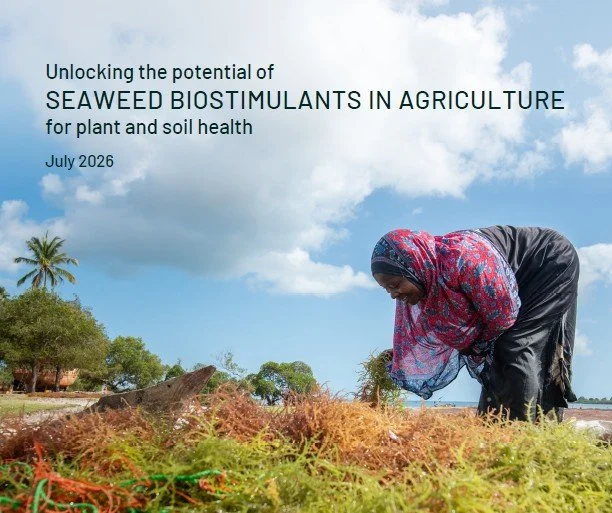
Click on Image to download full report.